project
Predictive Modeling & Data Insights Analysis
An empirical comparison of five supervised learning algorithms — Logistic Regression, KNN, SVM (RBF kernel), Random Forest, and Gradient Boosted Trees — across four UCI datasets, evaluating how well each model generalizes under different training set sizes.
Pythonscikit-learnpandasNumPymatplotlib
approach
- Built a shared preprocessing + model pipeline (median/mode imputation, standardization, one-hot encoding) for all five classifiers.
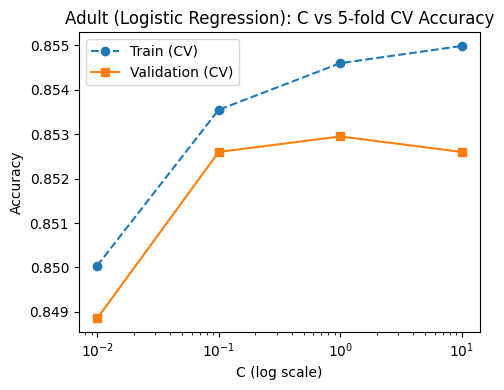
- Tuned hyperparameters per classifier with
GridSearchCVand 5-fold stratified cross-validation. - Evaluated each dataset/classifier pair across three train/test splits (20/80, 50/50, 80/20) and three random seeds — 180 experiments in total.
- Compared training, cross-validated, and test accuracy to analyze generalization and overfitting.
key findings
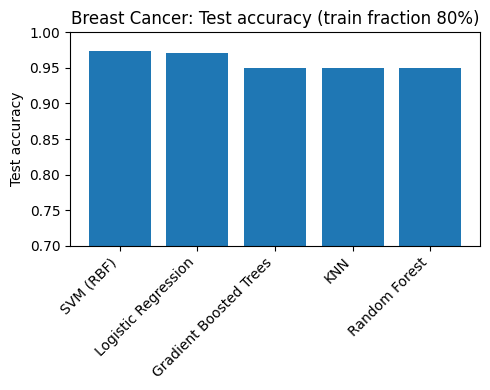
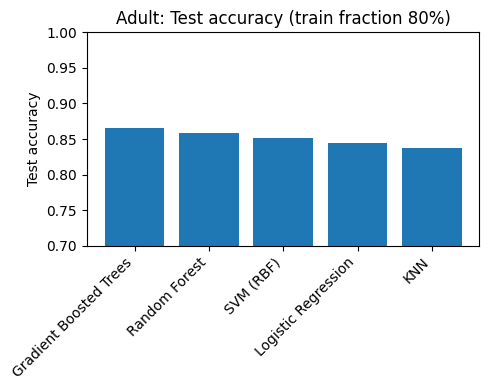
- Gradient Boosted Trees and Random Forest most consistently achieved the top test accuracy, with SVM (RBF) close behind.
- Logistic Regression was a surprisingly strong, stable baseline across all four datasets.
- KNN tended to overfit — high training accuracy but the weakest test accuracy, especially on larger datasets.
- More training data almost always helped, with the largest gains on the harder tasks and diminishing returns once a dataset was already large.
results
view code on GitHub →
Full methodology, tables, and discussion are in the written report on GitHub.